
B2B eCommerce / Wholesale operations
B2B eCommerce built around your real commercial rules.
We design wholesale platforms for approved partners, customer-specific pricing, company accounts, approvals and repeat orders — with WooCommerce, OpenCart or custom architecture.
When a B2B platform is needed
When wholesale cannot fit inside a standard retail basket.
B2B eCommerce should reduce repetitive work without bypassing the commercial policy. We begin with the way customers, sales teams, warehouse staff and finance actually work together.
- 01
Pricing is not the same for every customer
Each partner may have a specific price list, discount, credit term, tax rule or access to a controlled catalogue.
- 02
Orders follow commercial rules
Minimum quantities, case packs, quotations, approvals and repeat orders need to work without manual workarounds.
- 03
Customers and sales teams have different roles
Company accounts, sub-users, buyers and sales representatives need clear permissions and visibility.
- 04
The B2B store must agree with the ERP
Products, availability, prices, orders and documents need a clear source of truth and controlled synchronisation.
B2B commerce capabilities
Capabilities that support the commercial relationship, not only the transaction.
The exact scope comes from the business rules. We do not enable features simply because they exist; we implement what reduces friction and administrative cost.
Partner approval & restricted access
Account applications, validation, team approval and content available only to the right users.
Customer catalogues, pricing & discounts
Price lists by customer or group, contract pricing, volume discounts, controlled products and commercial agreements.
Quick & repeat ordering
SKU search, quick-order forms, saved lists, previous-order duplication and bulk import for professionals who know what they need.
Quotations, approvals & credit rules
Requests for quotation, internal approvals, purchasing limits, payment methods and flows aligned with the commercial policy.
ERP, CRM, WMS & accounting integrations
APIs, files or scheduled synchronisation with explicit ownership, monitoring, retries and exception handling.
Security, history & controlled administration
Roles, audit trails where required, protection of personal and commercial data, backups and operational documentation.
Workflow before interface
We clarify who decides what before we write code.
The interface is only the surface. B2B reliability depends on data ownership, permissions and what happens when a synchronisation or approval fails.
Systems of record
We define where product, price, stock, customer, credit limit and order data belong.
Roles & permissions
We map what each company, user, sales representative and administrator can see and do.
Happy paths & exceptions
We test standard orders, shortages, pricing changes, connection failures and cancellations.
Monitoring & ownership
The team knows when a flow fails, who is notified and how it can be restored safely.
Platform fit
We select the platform after understanding the rules.
WooCommerce, OpenCart and a custom application can all support B2B projects — with different limits, costs and paths for future evolution.
WooCommerce B2B
For commerce that needs a close relationship with WordPress content, marketing and a controlled plugin stack.
WooCommerce eShop development ↗︎02OpenCart B2B
For focused commerce, mature catalogues and businesses with an established OpenCart and extensions investment.
OpenCart eShop development ↗︎03Custom B2B platform
For specialised permissions, approvals, portals and business logic at the heart of the product.
Custom web development ↗︎04Existing B2B takeover
For auditing, stabilising and evolving a system that already operates and must remain available.
Technical support & takeover ↗︎Public visibility / private commerce
Commercial data remains private. The company remains visible.
We separate the public content that explains the company, markets and solutions from the private environment where partners see prices and place orders. Commercial agreements stay protected without abandoning SEO and GEO.
Explore SEO & organic growth ↗︎Selected B2B work
B2B projects with different access, catalogue and ordering rules.
The case studies explain the business problem and architecture without exposing private commercial information. See the Fire Fireworks OpenCart 4 rebuild, combining a bespoke theme with retail and approved B2B account access.

Mavtas
A B2C and B2B store for retail and wholesale customers, with an organised technical catalogue, focused search, direct purchases and quote requests.
OpenCartIndustry & technology↗︎
Fire Fireworks
We rebuilt fire-fireworks.gr from OpenCart 3 with Journal 3 to OpenCart 4 with a bespoke theme and a combined retail and wholesale model. The project brings together B2B account access, structured product discovery and recorded PageSpeed scores of 92/100 on mobile and 96/100 on desktop.
OpenCartEvents, weddings & entertainment↗︎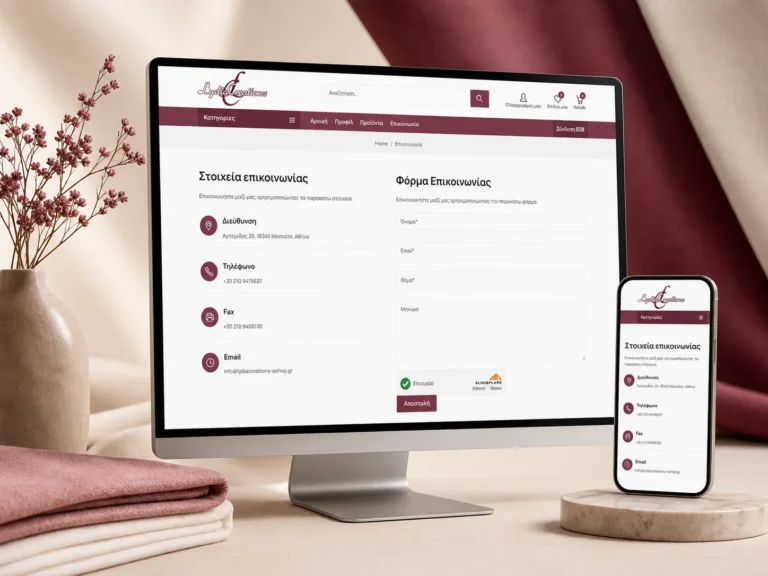
Lydia Creations
The WooCommerce store organises a substantial pyjama and homewear catalogue for consumers while a dedicated B2B registration flow supports professional partners inside the same commerce environment.
WooCommerceRetail & consumer brands↗︎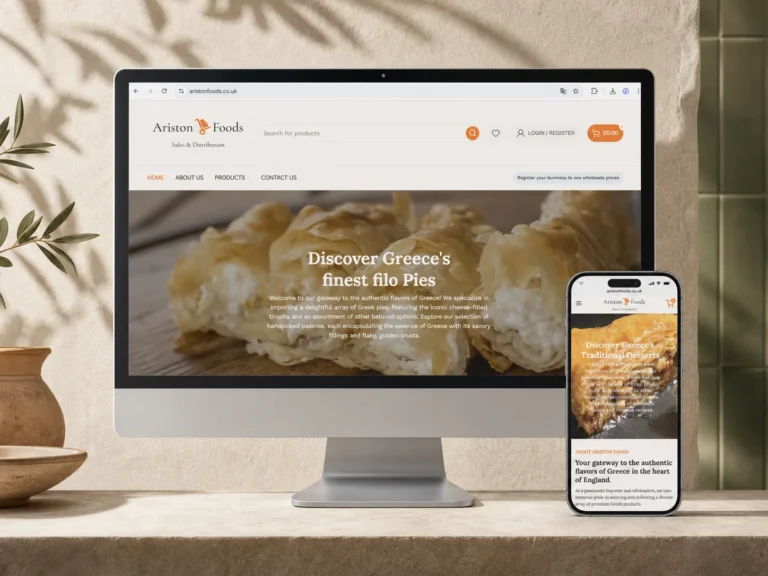
Ariston Foods
A wholesale store for professionals in the United Kingdom and Europe, combining controlled partner access, special pricing and a catalogue of Greek food, drinks and delicatessen products.
WooCommerceFood & beverage↗︎From commercial rules to launch
Five stages that reduce risk before real orders enter the system.
The B2B platform is delivered in stages, using real scenarios and the knowledge of the people responsible for daily operations.
- 01
Commercial discovery
We map partners, customer groups, pricing, catalogue rules, approvals, logistics and real operational exceptions.
- 02
Data & workflow map
We define each system of record and how products, prices, stock, customers and orders move between systems.
- 03
Professional buyer UX
We design fast discovery, bulk ordering, company accounts and clear information without unnecessary friction.
- 04
Build & integrations
We implement with WooCommerce, OpenCart or custom architecture and test permissions, pricing and edge cases.
- 05
Pilot, launch & evolution
We begin with controlled partner groups, monitor real flows and evolve the platform through safe, documented releases.
Start with the real workflow
Let us map the B2B process before selecting a platform.
Send us the catalogue, customer groups, main pricing rules and systems that need to connect. We will organise the right discovery.
Discuss your B2B platform ↗︎FAQ
What should be clear before B2B eCommerce development begins?
The right answers at the beginning protect the budget, data and daily operation of the business.
How is a B2B store different from a standard retail store?
A B2B store manages commercial relationships rather than isolated purchases. It commonly needs approved accounts, customer pricing, roles, minimum quantities, repeat ordering, credit terms and connections to internal business systems.
Can different customers see different products and prices?
Yes. Rules may be defined per company, customer group, country, commercial agreement or another controlled criterion. During discovery we decide which system owns each rule and how it is updated.
Can access be limited to approved professionals?
Yes. We can provide a partner application, validation and manual or automated approval. Public and private content remain clearly separated.
Can the B2B store connect to an ERP, CRM or warehouse system?
Yes, after the available interfaces, data, frequencies and edge cases have been assessed. The integration is designed as an operational flow with monitoring and a recovery path for failed synchronisation.
WooCommerce, OpenCart or a custom B2B platform?
The right choice depends on catalogue complexity, existing investment, pricing rules, integrations and future evolution. We do not recommend a platform before mapping these requirements.
Can it support quotations, approvals and repeat orders?
Yes. The scope may include requests for quotation, buyer approvals, previous-order duplication, saved lists and quick ordering by SKU or uploaded file.
Can B2B and B2C coexist in the same store?
Yes, when this matches the commercial model and the two experiences have clear boundaries. We review pricing, tax, content, checkout, SEO and permissions so one flow does not create problems for the other.
How does SEO work when much of the catalogue is private?
We create a public service and knowledge layer that explains the company, markets and solutions where appropriate. The private catalogue and commercial terms remain protected from indexing without removing the brand from organic discovery.
Do you take over existing B2B stores as well as build new ones?
Yes. We begin with an audit of architecture, data, integrations, security and real workflows before recommending improvements or a rebuild.