
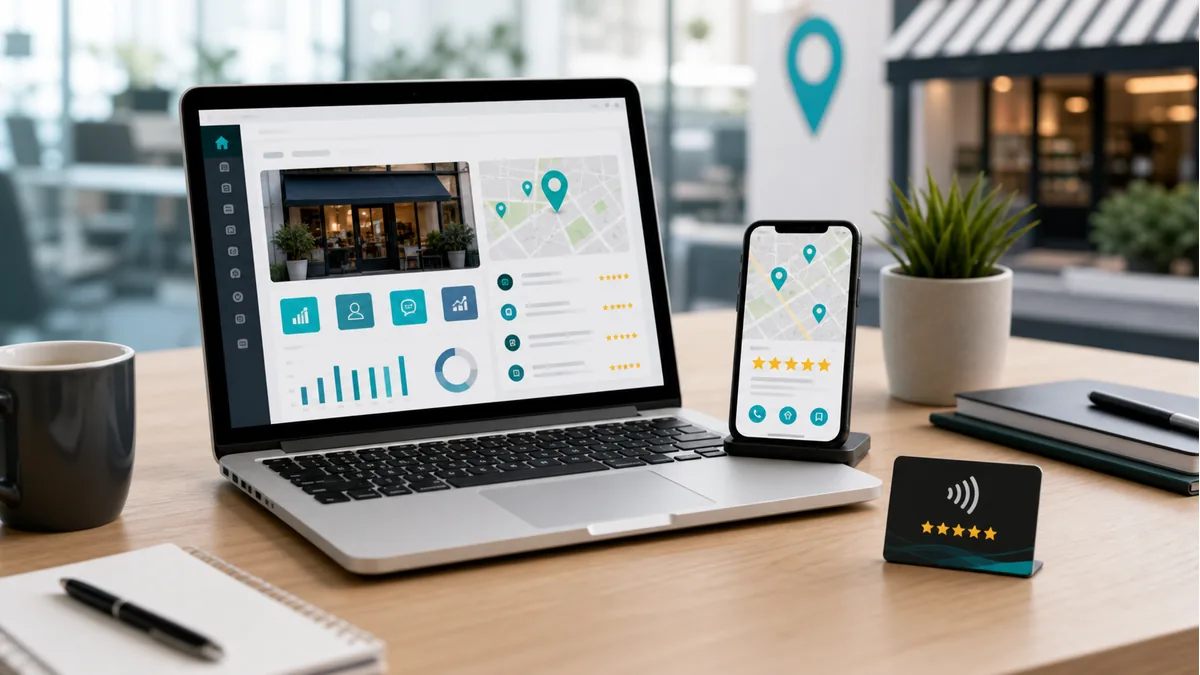
Local SEO is no longer just about appearing on a map. For a small or medium-sized business, it is the path that takes a searcher from discovery to trust, and from trust to contact. When someone searches for a local service, they do not evaluate only one result. They look at the website, Google Business Profile, reviews, photos, page speed, content, answers and consistency.
This guide explains how your website, Google Business Profile and customer reviews work together to generate real local leads. If your business already has a website but does not get enough local search traffic, the issue is usually not a single technical mistake. It is often that the parts of your online presence are not working as one system.
What local SEO means in practice
Local SEO is the optimization of your online presence for searches with local intent. The intent may be obvious, such as “website development in Patras”, or indirect, such as “e-shop development company” when the searcher is located in a specific area. Search engines combine signals from your website, business profile, reviews, links, user behavior and contact consistency.
That is why local SEO cannot be improved only inside Google Business Profile. It needs a strong website development foundation, clear service pages, fast loading, useful metadata and natural internal links to the pages where users can contact you or see proof of your work.
Your website is the foundation of local trust
Google Business Profile may create the first impression, but the website is where a visitor decides whether the business feels credible. A service page should answer three questions clearly: what you offer, who it is for and why someone should trust you. If the answer is too generic, local search visibility loses commercial value.
For example, a company that wants local leads should not rely only on a generic “Services” page. It needs detailed pages for core services such as corporate website development, e-shop development, SEO, WordPress support or any service that has real commercial value. Each page should have unique content, a clear H1, internal links, examples and a visible call to action.
Contact consistency is also important. Business name, phone number, email, location, working hours and address should be consistent across the website, Google Business Profile, social profiles and key directories. Small differences do not always destroy SEO, but they can blur trust signals and make evaluation harder.
Google Business Profile should not be disconnected from the website
Many businesses create a Google Business Profile, add basic information and then wait for results. That is rarely enough. The profile should reflect the same strategy as the website: accurate categories, services, description, photos, products where relevant, updates and links to the most relevant landing pages.
If you offer multiple services, do not send every visitor only to the homepage. A user searching for SEO should land on a relevant page about Google ranking improvement. A user searching for website development should quickly see the service, proof of work and a clear way to contact you. Landing page relevance helps both the user experience and lead quality.
Reviews are content, proof and a conversion signal
Reviews influence much more than the appearance of a business profile. They provide social proof, add natural language around services and locations, and help users make decisions faster. Quantity matters, but quality matters more. A review that explains the problem, the solution and the result is stronger than a simple “great service”.
The key is to have a process. A business should request a review at the right moment: after a completed project, a successful purchase, a positive support experience or a repeat collaboration. QR and NFC touchpoints can make this much easier. With a properly designed QR & NFC business promotion flow, the customer can reach the review page without searching for it manually.
How to structure a website for local search
A local SEO website needs structure. Adding the city name to a few titles is not enough. You need pages that answer real needs. A business serving multiple locations may need local landing pages only when there is real content behind them: services for the area, examples, industries, collaboration process, frequently asked questions and a clear value proposition.
These pages should not be copy-paste templates with a changed city name. Search engines can easily detect thin or repetitive content. Every local page needs its own angle: what businesses in that area usually need, what problems the service solves, how remote or local collaboration works, and which projects demonstrate experience. This is where links to completed website projects become valuable proof.
Content that matches user intent
Local SEO content should cover the full customer journey. At the beginning, users search for general information: how much a website costs, what an e-shop needs, how to appear higher on Google. In the middle, they compare options. At the end, they want proof, clear next steps, a way to contact you and confidence that they are talking to people who understand their business.
This is why the blog should support commercial service pages. A blog article explains the problem, a service page presents the solution and a portfolio project proves that the solution has been applied. This journey makes internal links useful and natural, not just links added for SEO.
Technical details that should not be ignored
Local SEO also has a technical side. The basics include indexable pages, correct canonicals, schema, speed, mobile usability, clean URLs and accurate metadata. If the visitor arrives from a mobile device, the page must load quickly and make it easy to call, submit a form or open a map. A slow or confusing page can waste even strong rankings.
Structured data helps search engines understand the business, pages, articles and services more clearly. It is not a magic ranking button, but it reduces ambiguity. For local businesses, Organization or LocalBusiness schema, WebPage schema, Article schema for blog posts and Service schema for important service pages can all support clarity.
A practical 30-day local SEO plan
If you want to start in an organized way, a simple 30-day plan can build a strong foundation:
- Days 1-5: Audit the website, titles, meta descriptions, H1s, speed, mobile experience and basic technical issues.
- Days 6-10: Clean up Google Business Profile categories, services, description, photos and contact information.
- Days 11-15: Create or improve key service pages and local landing pages where there is real search demand.
- Days 16-20: Build a review process using QR/NFC, email follow-up or a direct review link after service delivery.
- Days 21-25: Add articles that answer frequent customer questions and link naturally to services.
- Days 26-30: Review Search Console, call/form tracking, CTAs and internal links.
Common mistakes to avoid
The most common mistake is focusing on only one part of the system. Some businesses rely only on reviews, others only on the website, others only on Google Business Profile posts. The result is fragmented. The second mistake is duplicate local content: many pages with almost the same text and only the city name changed. The third is a lack of measurement. If you do not know where a lead came from, you do not know what is actually working.
Another issue is the absence of proof. Users want to see work, not only promises. Service pages should connect to projects, examples, case studies or at least specific outcomes. Local SEO is not only about being found. It is about being trusted when someone finds you.
Conclusion
Effective local SEO is a system. The website provides depth and credibility. Google Business Profile provides visibility in local search. Reviews provide social proof. Articles educate, service pages convert and projects prove capability. When all of these parts are connected correctly, the business is not just chasing impressions. It is building a stable presence that can generate better leads month after month.
If you want to discuss how your local online presence can be improved, you can contact Firstidea through the contact page.