
Automotive digital systems
Automotive websites that organise services, vehicles and trust.
We design websites for garages, dealers, electric mobility, parts and B2B automotive companies with structured technical information and journeys that lead to the right enquiry.
From interest to the right action
Visitors should not have to search through a generic catalogue.
Intent changes when someone needs a service, vehicle, part or technical partnership. The structure needs to recognise that difference.
- 01
Services become specific
Work types, brands, vehicle categories, service areas and prerequisites are clear before an enquiry.
- 02
The catalogue remains useful
Vehicles or products use real filters, availability signals and defined next steps.
- 03
Leads arrive with context
Forms request only the vehicle, service and timing details needed to qualify the request.
- 04
Local demand meets proof
Locations, hours, expertise, work and useful information support local visibility and confidence.
Automotive content model
Six foundations for different automotive models.
A garage, a dealer and a technical catalogue are not treated as the same business.
Garages and servicing
Work types, brands, diagnostics, bookings and responsible technical guidance.
Dealers and showrooms
Vehicles, filters, finance, trade-in and qualified expressions of interest.
Electric mobility
Vehicle categories, range, charging, specifications and after-sales information.
Parts and equipment
Models, codes, compatibility, B2B access and stock connections where required.
Heavy vehicles and B2B
Fleet services, contracts, technical documents and professional enquiry journeys.
Ownership content
Maintenance guides, technology and FAQs with transparent authorship and review.
Data before decoration
An automotive website works when its data has structure.
Model, service, location, availability and compatibility are more than display fields. They determine search, content and integrations.
- 01
Clean taxonomy
Brands, models, categories and services without duplicated filters or dead-end URLs.
- 02
Source of truth
We define which system owns pricing, stock, availability and specifications.
- 03
Measurement plan
Calls, enquiries, bookings and downloads remain distinct business actions.
- 04
SEO crawl control
Indexable pages only where standalone value exists, with controlled faceted navigation.
Related work
Automotive experiences with different operating foundations.
These projects show the difference between a technical service, mobility commerce and catalogue operations.
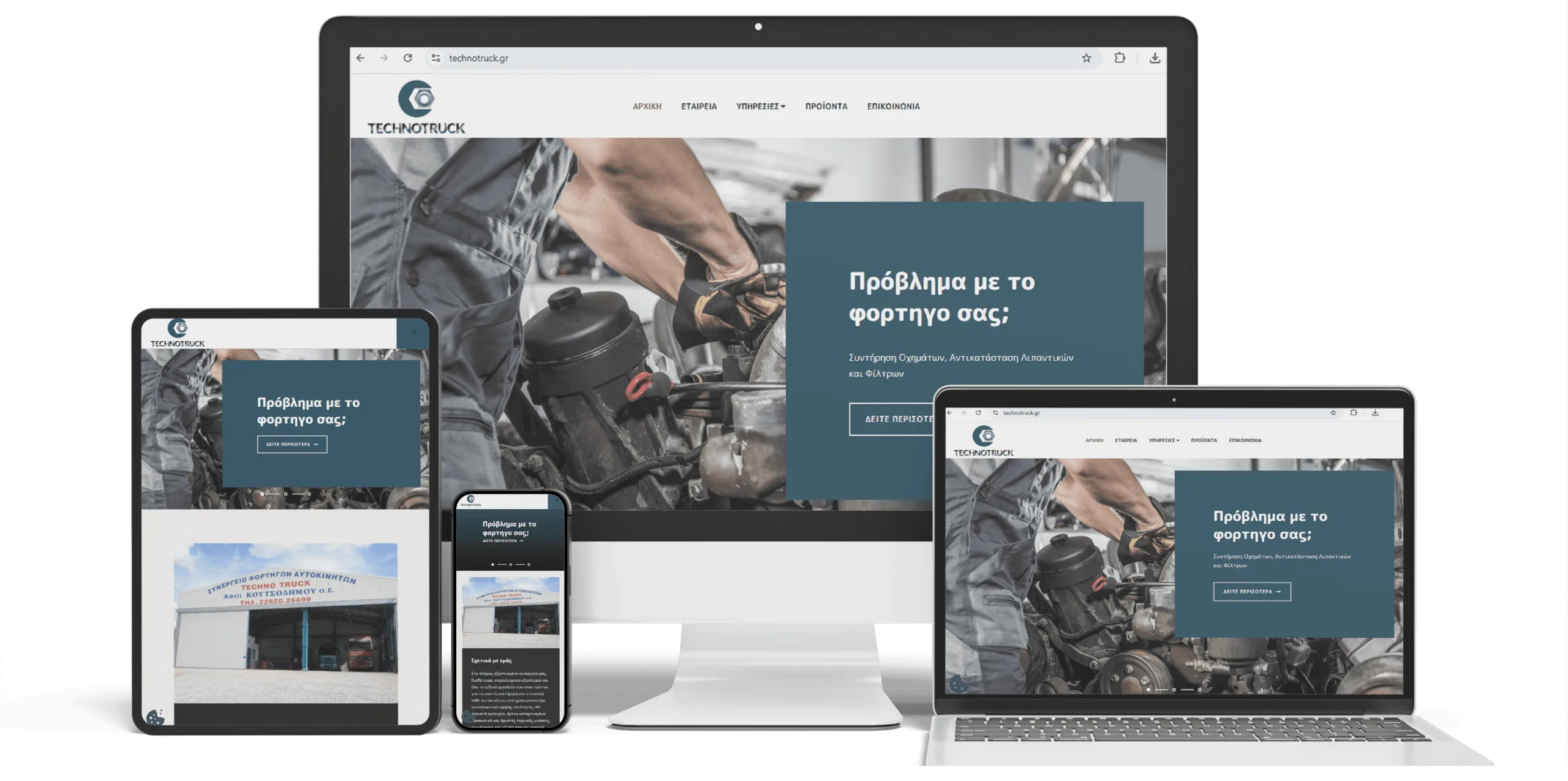 Truck service · B2B
Technotruck
Heavy-vehicle services, professional information and B2B functionality.
View the case study OpenCart · Electric mobility
Electrokinisi Aigiou
A technical vehicle catalogue supported by automated supplier updates.
View the case studyA controlled delivery path
From operational discovery to a website the team can run.
The stages remain visible, while the research, content model and acceptance checks adapt to the sector.
- 01
Operational discovery
We map audiences, services, locations, content, enquiries, integrations and ownership.
- 02
Search and content architecture
We define entities, page types, URLs and internal links around genuine questions and decisions.
- 03
UX and visual direction
We design the key journeys and a distinctive system that remains usable across devices.
- 04
Development and migration
We build on the appropriate stack, preserve valuable URLs and connect agreed operational tools.
- 05
QA, launch and care
We test content, forms, analytics, accessibility, performance and ownership before launch.
Quality built in
A durable foundation—not a short-lived landing page.
The same non-negotiable standards support every specialised solution.
SEO and GEO architecture
Semantic templates, entities, metadata, structured data and answer-led content without manufactured claims.
Performance and resilience
Lean assets, sensible dependencies, monitoring, backups and a documented recovery path.
Accessibility and privacy
Keyboard journeys, contrast, labels, data minimisation and clear consent boundaries.
Ownership and support
Controlled access, maintainable code, editable content and technical responsibility after launch.
Automotive project
First, let us define which journey needs to work.
Tell us whether the primary objective is servicing, catalogue discovery, booking, selling or B2B partnership. We will recommend the right architecture and stack.
Discuss your automotive websiteFAQ
What should be clear before the project begins?
Practical answers about scope, content, technology and long-term ownership.
Do you build websites for garages and vehicle dealers?
Yes. The structure adapts to garage services, vehicle inventory, technical catalogues, electric mobility or B2B operations.
Can a vehicle or parts catalogue be connected?
Yes, after defining the data source, fields, update frequency, filters and publication rules.
Can the site support online service bookings?
Yes, through a form, booking system or integration based on capacity, shifts and the real confirmation process.
How is this different from a car-rental landing page?
Car rental focuses on fleet, real-time availability, dates, locations, extras and payment. This broader automotive page covers service, dealers, products and B2B.
Will the website be built only for search engines?
No. Search visibility begins with a useful service, a clear information model and honest proof. SEO and GEO help that value become understandable; they do not replace it.
Can you preserve the rankings of an existing website?
We inventory URLs, landing-page queries, backlinks, metadata and internal links before migration. Redirects are used only when a documented URL change is genuinely necessary.
Can the website be multilingual?
Yes. Each language receives a real information architecture, localised copy, navigation, metadata and reciprocal hreflang—not an unreviewed machine translation.
Do you provide support after launch?
Yes. Support can cover hosting, monitoring, security, backups, updates, content changes, analytics and planned development.